Monday, November 18, 2024

Ancestry Results using ThruLines

 I first received my ethnic results from Ancestry. On its site for the last five generations technically I show up all white. it does not offer deep ancestry reports. However DNA results confirmed my theory that my paternal revolutionary war veteran Isaac Beman married Lydia Wix whose father Zephaniah had Native American ancestry. He was from Southern Connecticut. I was very surprised and pleased by these results.


Also on this side we finally know the Bakers were German. Gggreat-grandfather Daniel Baker's father was Rudolph Baker from Shenandoah Co, Virginia. The ancestor immigrated to Philadelphia before the revolution. 

Gggreat-grandfather Albert Galatine Gatton was the biological son of Galentine Gatton. No one researching the family thought he was. He was the eldest son and no documents have been found. It took me many years to find another man in my families, who just missed being entered into the 1880 and 1900 federal census records.

There were no matches for ggreat-grandmother Sarah Livingston. I know there are a few thousand Livingston trees on Ancestry. I wonder how many tested their DNA. Maybe they felt they didn't need to because the family is very well known in the area.

I am still in the dark about my great-great-grandfather Alexander M. Thatcher born in 1818. In Pennsylvania or Massachusetts? I still don't know. 

My maternal Wilson ancestor was different. The male line led to Fairfield, Connecticut and then Massachusetts. The biological father for Nathaniel Wilson born 1742 was Richard Wilson born 1715, not the Nathaniel many people thought it was. The immigrant ancestor arrived in Salem, MA, in 1638. That was very unexpected, but considering the very common surname, even duplicate first names Nathaniel and William, that's not unexpected. It was a big surprise to my maternal family because everyone thought we were Scottish. The Wilson trail led to Normanby le Wold, Lincolnshire, Britain. Thanks to a confusion in duplicate first names in Lincolnshire, this time Thomas and William, I don't know if the family came from Yorkshire or Fife, Scotland. At least I know Hamon Wilson is my ancestor.

On the same side I found out a distant cousin was correct about the father for my ancestor Joseph Peavler. His father was Christian Bibler. The original family name was Büehler. The family immigrated to the Germanna Colony in Virginia in the early eighteenth century. 

My ancestry was given as 31 percent German. I had no idea I had that much ancestry when I took the language in college. From my ancestry I could be related to my German professor Waltraut Deinert! She was from Hessen.

Those were the major corrections. There were a few additional parents added to trees, but I didn't get far researching them. All the other five generations of information were correct. There were a few additional parents added to trees, but I didn't get far researching them. All in all that is a pretty good confirmation of my research started before the use of records on-line. 


Catching Up in Genealogy

 I am finally catching up with genealogy developments.  Recently I had my DNA tested.  I have enjoyed genealogy over the past couple of decades and it was a natural extension of skills and my curiosity.  When DNA testing was first marketed, I couldn't afford it and I knew if I waited the technology would develop further and I would get more results.

My mother participated before I did, many years ago. She joined the National Geographic's Genome Project.. It confirmed she had deep ancestry from western and northern Europe, around the Mediterranean, Arabia, the Fertile Crescent, northern Asia, and southern Indian.  At that time any Native American DNA would show up as Asian. Her MtDNA led to a Ukrainian Jewish woman.  I am still very puzzled about that.  I haven't documented any Jewish people on either side of the family.

I came to the point that I was mostly interested in my brick walls in research. A distant cousin gave me an Ancestry autosomal DNA test.  After being laid off, my personal interests helped me reinvigorate myself. It was time to tackle the brick walls. 

Tuesday, November 5, 2024

Time Team Member


I am thrilled to say I am a member of Time Team. It started thirty years ago in Britain as an reality archaeology, based on the premise that the usual archaelogical survery takes three days.  The reason i became interested was a little bizarre.

I have lived in upstate New York all my life. I had already started researching my family in 1994 and knew I had a diverse European background. In August 2014 my mother broke her hip. She had to go to a rehabilitation center.  One beautiful day in September she wanted to go outside.  I took her out in her wheelchair.  I wonder if all wheelchairs are so cumbersome to move and manuveur. I strained my right shoulder badly.  I just gotten a job that required using a computer all day.  The only thing I did at night after that little incident was eat a frozen dinner and ice my shoulder.  I needed some entertainment.  I got a subscription to the Britbox streaming service and that's where I found Time Team.  The service had a very limited number of episodes it turned out.  I wondered if there were more.  There were, 20 years and 62 specials!

It was an easy and entertaining way to learn about my British ancestors.  There were episodes in Scotland, Wales, and Ireland as well.  It seemed like a lot of the people knew each other and it wasn't unusual for people to give each other a good-natured hard time.  At that time I never knew where the team would be in the next episode or what they would find.  Sometimes they found what they were looking for.  Sometimes they found something else entirely.  One time they found "absolutely nothing." Each episode featured at least one specialist and as the years went on, usually multiple.  I've watched them countless times since then.  It's sort of like attending a really good party, at least for me.

The episodes ended in the early 2000s, but the interest and enthusiasm continued on.  I think the pandemic helped too.  So many interesting channels started on YouTube!  A few years ago it was announced that Time Team was reforming and would be fan-funded.  There has been at least two special digs in the last two years, and information in-between.  This past spring I thought I'd join.  This is the type of group would welcome me if I showed up one day to watch and someone would go out of their way to talk to me.  Too bad I can't. I've had a couple dreams of Time Team coming for a dig in the upper Hudson Valley.  Hint, hint.

Saturday, September 14, 2019

Ephraim Warfield in the American Revolution

I haven't had much time to work on genealogy, although I've felt like getting back to it. My mother wanted me to finish my research enough to write and publish it, along with several friends.


A cousin from another branch of the Winchell family is Officer Keith A. Winchell of the NYPD, shown here during an August 2016 promotion ceremony. He is an Air Force veteran and a first responder to the World Trade Center. I have found out something very interesting about his great-grandmother Harriet Austin Winchelll's family and I'm working on documenting the information to give to him. Goals are always subject to revision.

I have hit a snag. One of his ancestors is Ephraim Warfield, born 1 Oct 1760 in Westfield, Hampden Co., Massachusetts. He served multiple times during the American Revolution on the Patriot side. I have discovered that there was also an Ephraim Warfield from Connecticut who also served in the same war. I have to sort out which man served when where. There's only one local library with Fold3 so I'll have to visit there.  The Ephraim from Connecticut applied for a pension so hopefully I'll be able to read the documentation and find out where he served.  I have a feeling it might be in Rhode Island. Fortunately there's a library near work and it'll be easy for me to go there to use Ancestry. This is a good example why a person always has to be careful about people of similar ages with the same name.

Friday, June 7, 2019

Survey

I need help determining a man's early origins. I know who he is, so I don't need anyone to guess who he is. It is very important you take the questions at face value only. Below are the clues that I have.
  • He belonged to a tribal band.
  • His father belonged to the same Native American tribe and gave him land rights.
  • He signed a treaty as a member of his tribe.
  • A Native woman signed a quit claim deed giving him land.
  • His tribe gave him land.
  • He married a European woman in a Christian church.
  • He was baptized a Christian, but the baptismal record is missing.
  • A record of his membership to any Christian church hasn't been found.
  • Some of his children were baptized Christian.
  • Some of his children attended a mission school.
  • He operated a sawmill.
  • He deeded land to his European brother-in-law.
  • He had a European last name.

The question is: based on the information provided, did this man grow up in a European family? YES or NO response please.

Thank you very much for your help.


Sunday, April 28, 2019

Genealogy Goals

I think it would be a good idea if I set some genealogy goals for myself.  Because work management has always been rating me and my allergies always interfere, goals don't work well in my personal life.  However, it's probably a good idea in genealogy because once your tree starts developing, you can go off any which way.

My goals:

  • Document Debra Winchell's wife to Anthony (Teunis) Brazee and if she was the daughter of Eliakim Winchell Sr.  Tricky since the Town of Egremont records burned and the family weren't church goers.
  • Find the parents of great-grandfather Alexander M. Thatcher. He probably did come from Chester County, Pennsylvania, or thereabouts.
  • Try to link gggreat-grandmother Sarah Livingston to the Livingston family of upstate New York.

Saturday, December 22, 2018

Using Amazon a Different Way

I just realized there's another way to use Amazon as a perennially cash-strapped researcher.  I can compile a bibliography of books I want to read and then borrow them through inter-library loan.  In addition, if the authors are still alive, I am also able to contact them to ask for suggestions on resources. 

It is not easy trying to research ancestors when I live hundreds of miles from here they did.  There is no web site that has all the information you could ever need from any area.  Research is even more difficult when your ancestors were sociopolitical minorities in the area. 

I've been trying to find where my great-great-grandfather Albert Galatine Gatton came from for years.  He was born about 1819 in Ohio and Native American.  He died of pneumonia in Corinth, MS, while serving in the Union Army during the Civil War, so there is no death certificate.  His marriage record to my great-great-grandmother lists no parents.  I was able to find a record for his first marriage to Hannah Wyckoff on 15 March 1838 in Muskingum County, Ohio, still with no parental information.  It still doesn't mean he was born there, either. 

James Gatton and his wife Rosannah Canner lived in the area with their family.  Tantalizingly one of their sons was named Galen.  I don't know if they were related or not. Even if they were, I would still have a Native American ancestor to find.  I think it's most likely it was a Native wife. 

Fortunately in this time period there weren't that many people in Ohio to research.  There is one core Gatton family. It has a son named Greenberry Gatton whose history goes unrecorded.  I don't know if that's because he died young or if the family lost touch after he became an adult.  The only way I can think of proceeding is to read about the early histories of Native Americans and Europeans in Ohio.  I think it's possible that Albert's father was trading with Native people and met his Native wife that way.  With any luck there might be an early record with Greenberry's name on it.

I have another mystery ancestry in the same area, Solomon Hise.  He is my mother's ancestor.  He was Native American.  He belonged to the United Brethren church.  That sect was the only one that Native people in Ohio trusted.  I don't believe the parents that people have documented for him because it shows no Native ancestry.  I really haven't worked on his background very much yet.  I hope to.


Sunday, August 12, 2018

New DAR Member

Friday after work I was absolutely amazed to find I'd been sent in the mail a certificate of membership to the Daughters of the American Revolution, with my member number.  I had given up hope completely that I would be able to get my Mohican-Wappinger-German ancestor Eliakim Winchell recognized as a patriot soldier during the American Revolution.  I thought the facts that the town records burned, he didn't go to church, didn't need to pay taxes and was illiterate were ones that the DAR couldn't accept.  I was wrong.  I was given no explanation, though.

I think I am still a little too radical for the DAR.  My main goal was to have Eliakim recognized.  I'll have to wait and see.  I may want to apply under a maternal ancestor in memory of my mother, though.  It would only be fair.

Maternal American  Revolutionary War Ancestors

Berryman Brown
Richard Brown
Samuel Brown
Noah Hayden
William Hayden
Edward Houchins
Christopher Peavler
Cornelius Vanderveer
Richard Wells
Sampson Wickersham
Nathaniel Wilson

It's possible a Daniel ancestor served, too.  I have my choice, don't I?  I think it should be under Nathaniel Wilson or Cornelius Vanderveer.  It's difficult to document Wilson's service because he signed so many applications as a judge for other men! 

Saturday, July 21, 2018

New Thatcher Information

For years I've been stuck on the parents of my great-grandfather Alexander M. Thatcher. It appears he was born in 1818 in Chester County, Pennsylvania. I've been researching for 24 years. Today I've finally found something useful on Ancestry. It's a census of Chester County in 1779 listing all the Thatcher men. It also has wills of Thatcher men in Pennsylvania. I'm sure not all the men had wills. I can use this information to research these men to see what sons they may have had in the county later on, who would be potential fathers or grandfathers of Alexander Thatcher. I wonder what I will find.

Monday, May 28, 2018

Still Here

I'm sorry it's been so long since I've written.  I was concentrating on my mother's side of the family.  A while ago I created Wabash Valley Families for her side of the family.

On 4 March 2017 my elderly mother broke her lower right leg in two places.  She was sent to a very poor rehabilitation center where first she was neglected and then she contracted the antibacteria-resistant gastrointestinal infection clostridium difficile that took her life a year and a month later. She also contracted a skin infection that the staff completely ignored. Even before breaking her leg, Mom was experiencing serious side effects from the cholesterol and high blood pressure medicines she was taking. I tried to get her out of the nursing home, but I couldn't.  The only way my mother got out of the center was through a septic episode that sent her to the hospital.  She didn't go back.  The second place was so much better it was like night and day, but it was already too late.

My mother wanted me to continue with my research and publish the books I intended to.  I'm hoping sometime soon I'll have the energy and desire to do so.  I hadn't realized how stressed out and tired I'd become, as the only adult child.

Juanita Wilson Winchell
1932-2018
Juanita M. Winchell, 85, lost her long battle against the antibiotic-resistant gastrointestinal bacteria clostridium difficile on 4 April 2018. at Timberlyn East Nursing Home in Great Barrington, Massachusetts.
Juanita was a long-time resident of Columbia County, residing in Philmont and Hudson, N.Y. She most recently resided at Bethany Village in West Coxsackie, NY. She worked in several sewing mills in Columbia County. She retired from Sunoco Crellin Plastics in Chatham, N.Y. where she was a press attendant, head trainer, and member of the initial McDonald's product team, receiving an award at corporate headquarters for process improvement in 1998. She was a Girl Scout troop leader and participated in bowling teams in Hudson and in the Columbia Memorial Hospital Auxiliary. Juanita also obtained training in reflexology, Reiki and furniture refurnishing. Decades ahead of business trends, Juanita attempted to establish a business sewing and selling reusable fabric shopping bags. After retirement, she earned her real estate license and worked for Barns and Farms Realty in its Germantown and Hudson offices. She adopted several cats from the Columbia-Greene Humane Society. She greatly appreciated her British Isles, colonial Dutch, and Native American ancestry.
Juanita was born in Torrington, Conn., the daughter of Frederick E. Wilson and Mary M. Vandivier. She is predeceased by her parents; brothers Harvey, Sidney, Richard, Everett, Donald, Raymond Wilson; sisters Mildred Alstrup, Florence Davis, Dorothy Baccei, Nina Joyce Carrozzo; and her former husband Avery Winchell. Survivors include daughter Debra, sister Edna Westmoreland and many nieces and nephews.
There will be a private funeral service at Gleeson-Ryan Funeral Home in Torrington, Conn. Internment will be in Hillside Cemetery, Torrington, Conn. next to family members. Contributions in Juanita's memory to the Peggy Lillis Foundation, 266 12th Street #6, Brooklyn, NY 11215 would be appreciated to help prevent further clostridium difficile deaths.


Saturday, July 15, 2017

Winchell Family Reunion!

I have almost achieved another goal of my family research, attending a family reunion, and I didn't even have to put it together.

My Aunt Kate has told me more than once that her father always wondered what happened to everyone else in the family.  I won't say that's what compelled me to research my family, but it was probably a contributing factor.

It wasn't until I was fully adult that I met someone outside my immediate family with the same last name.  I started researching my family in earnest in 1994, finding out where the family came from and what happened to its members. It was only a few years ago, after 2009, that I came into contact with someone from another branch of the family.  That led to my invitation to the family reunion.

It also led to the awareness of old family photos being held by some family member.  I am hoping somehow that the family reunion leads to my viewing of the photos.  I guess those have been my Holy Grail.

I'm hoping to put together a display for the reunion.  It hasn't seemed to me that the family knew much about its history.  It's going to be something of a challenge.  My elderly mother has to go into a rehab center to rehabilitate from the neglect she suffered from the awful rehab center that she was originally sent to March 10th.  While I am pretty sure that the new center will be a good place for her, it's also an hour's drive from home.  My personal life has suffered greatly in my efforts to support her, rescue her from the original center's grip, and find a better place for her. Normally I would greatly enjoy preparing from this.  I hope I can tap into that joy.  Wish me luck!

Saturday, March 25, 2017

Musings on the Buckalews

I'm in the habit of working on my genealogy on Saturday mornings while listening to my favorite radio programs Car Talk and Wait, Wait, Don't Tell Me. A while ago I determined that my ancestress Sarah Livingston was probably descended from Rev. John Livingston and a relative of the New York Patroon Robert Livingston that gave her husband George Winchell's family such grief in western Massachusetts. From the reading I've done, it seems like all the early Livingstons were descendants of Rev. Livingston.  Until I have the time and patience to visit the history room of the Troy Public Library to see if I can find the records that show just how Sarah is descended from him, I've been slowly adding ancestors to Rev. Livingston's tree from information on-line. 

I found some very good information on Electric Scotland and thought I'd look to see what the site had on the Scotts.  The Buckalews are descendants of Clan Scott, and my great-grandmother Margaret Gatton's ancestors.  The current chief, the Duke of Buccleuch, paid for genealogical research that proved the Buckalews were descendants of the Scotts. I just wish he'd publish the research. 

Here's another case where I need to build the path back to Scotland. One family story is that the ancestor was a soldier in the Netherlands. I believe I just found the origin of the story on Electric ScotlandWalter, second Lord Scott of Buccleuch, was created Earl of Buccleuch in 1619. 
"and entered the service of the States-General, as he did, at the head of a detachment of Scotsmen, though, strange to say, only half-a-dozen of them belonged to his own clan and bore his name. He was present at the sieges of Bergen-op-Zoom and Maestricht. As Sir Walter Scott says of him, ‘A braver ne’er to battle rode.’ He was recalled from the Netherlands, in 1631, by Charles I., who desired his presence in London, as his Majesty had occasion for his services, but he subsequently returned to his command in the Netherlands, and was in active service there six weeks before his death."
 Earl Walter enjoyed having people around him and entertaining. Novelist Sir Walter Scott wrote this verse about our social kinsman:

‘Nine-and-twenty knights of fame,
Hung their shields in Branksome Hall;
Nine-and-twenty squires of name,
Brought them their steeds to bower from stall;
Nine-and-twenty yeomen tall
Waited, duteous, on them all:
They were all knights of metal true,
Kinsmen to the bold Buccleuch.
‘Ten of them were sheathed in steel,
With hiked sword, and spur on heel:
They quitted not their harness bright,
Neither by day, nor yet by night:
They lay down to rest
With corslet laced,
Pillow’d on buckler cold and hard;
They carved at the meal
With gloves of steel,
And they drank the red wine through the helmet barr’d.
‘Ten squires, ten yeomen, mail-clad men,
Waited the beck of the warders ten;
Thirty steeds, both fleet and wight.
Stood saddled in stable day and night,
Barbed with frontlet of steel, I trow,
And with Jedwood-axe at saddlebow;
A hundred more fed free in stall:-
Such was the custom of Branksome Hall.’

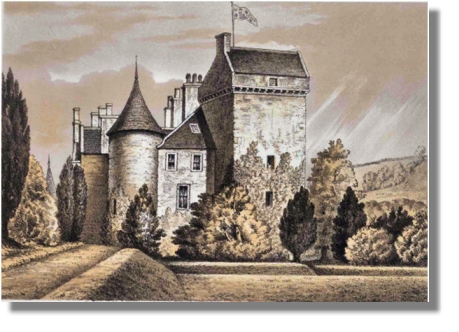
Branxholme

Branxholme Castle
Major reasons Scottish people came to the British colonies of North America were because they were banished as border rievers (which the Scotts were at one time), they were Protestant Covenanters who opposed Catholic King James II or they were dispossessed by the Highland clearances. During the life of Earl Walter's successor, Francis, Second Earl of Buccleuch, the family's story changed from that of riever to Covenanter.  The page states that Francis also had a brother and six illegitimate half-siblings, but their histories aren't given. I'm not certain which family line Frederick Buckalew came from.

Did you know that castles were originally built by the Norman conquerors of Britain to maintain control of their new subjects?  They were square, stone structures of French origin. The Normans built at least 420 castles after conquering England. 


Saturday, February 25, 2017

Maple Sugaring

I felt compelled to change the blog background to what was the normal seasonal activity in my area, maple sugaring.  It was a food-gathering activity that Europeans learned from the resident Native Americans.  Before the Europeans came, this was the primary source for a sweetener for the Native people.  It was an activity that anyone could do.  It has become a big business in New York and New England, an important one in rocky areas. 

This past winter is about the mildest I remember. I've lived through 57.  There was only a week or two of bitter cold before the winter solstice.  After that the temperature didn't go below zero Fahrenheit.  The temperatures bounced back and forth from the twenties and the thirties.  We didn't have a snowstorm until February.  Maple trees need the normal cold winter night to produce the amount of sap we're used to.  I love the lovely, shady maple trees and the maple syrup we produce from their sap. I'm very worried for them. 

Sunday, January 8, 2017

Pardee Connection Made


I have connected with a descendant of Rev. Ira N. Pardee and Mary Lucinda Winchell.  Unfortunately she doesn't have much knowledge of the pioneer generation to the Mid-West.  She was able to tell me that their daughter Eva had red hair.


Eva W. Pardee married Harold Chester Peters 11 October 1893 in Cortland, NY.  Their sons were Harold Pardee Peters and Chester Lewis Peters, both born in Sioux City, IA.  Harold passed away in that city 2 July 1950.  


Eva lived to be 103 years old, passing away 18 Jan 1974. Is it my imagination or does she look to be a high-spirited woman?  


Her great-great-great-granddaughter was tickled to finally have information on her family.

The Motivation Behind My Research

I recently found this quote when I was investigating a potential purchase of a book:
"[James Joseph] Buss persuasively argues that the removal of the .American Indians from the landscape of the lower Great Lakes region was intertwined with and reinforced by a much longer process of writing those same Indians out of the historical narrative of America western expansion and the growth of the United States."  (The American Historical Review, Vol. 118, Issue 1, p. 182.
I realized that I and many others have been trying to correct this and trying to put Native Americans back into the historical perspective.  My efforts have been to show that Native people have always been part of American society, albeit in different ways in different regions.  My Mohican ancestors did not move west like their relatives.  They stayed in the homeland for a long time.  They became farmers, carpenters, mill workers, railway men, businessmen, Methodist ministers, musicians, postmasters, medical practitioners and one banker. There are many military veterans.  Whose lives didn't they affect?

Life was more fun when I had more time to write.  Real life interferes too much.  I am hoping to get back to the practice.  I may reach that point when I finally go to the Troy Public library to research James Livingston in Rensselaer County.

I've been researching part of an unrelated family for a cousin from a different branch.  This is not information I feel I can share here.  It was fun to do, though, and I get a thrill anyway from the interesting discoveries.


Sunday, October 16, 2016

Livingston Clue Doesn't Work

I stopped at Clermont State Historic Site today and looked through the Livingston genealogy in the visitor center.  My Livingston clue did not fit into the published genealogy.


Here is a graphic representation of the relationships I found.  I think Catherine Livingston was related to Sarah Livingston.  Here are my reasons why.
  • Catherine was born five years after Sarah, in Castleton that is not terribly distant from Ancram where my gggreat-grandmother Sarah Livingston was supposedly born, or Hillsdale where Sarah's mother Rachel was born.
  • Catherine and Sarah both had a mother named Rachel.  Her father was listed as James, a common Livingston given name. Sarah's father was listed as Daniel, and I'm not sure that was correct.
  • Catherine married Sarah's son-in-law's brother and ended up living in the same area, What brought Catherine to the area in the first place?  To visit Sarah?  
I have to find out more about James Livingston of the Castleton area.  I also want to see if I can find anything about Rachel Boyes' marriage to Lawrence Vosburgh.  He was her third husband. Possible branches Sarah may have come from is James Livingston in the same area as the patroon; Washington County, New York; or Wallingford, Connecticut.  From what I read on-line, those branches all go back to the same Livingston family in Scotland.


Sunday, April 3, 2016

Correct Location of Indian Field

After reading both archaeological surveys of Indian Field, I knew I had to determine for myself where Indian Field was located.  With any report, certain questions are being asked and data analyzed, determining the author's viewpoint.  

I realized the information laid in the maps.  Here is the original Simcoe map, contemporary to the battle:


Here is the Simcoe map superimposed on a modern map of the area:


Here is my rough estimate of where Indian Field truly lies in the modern landscape:


I present this in hopes that other people will confirm what I see.  I'm at a loss for knowledge of the area since I've never even visited it.  I don't know what that little brown Indian Field section is at the bottom.  I don't know if the officially designated Indian Field, the location of the DAR monument or a ball park with the name. It is clear, however, that much of Indian Field has already been destroyed by Euroamerican construction.  It is a clear sign that Indian Field needs guardians.   More on that in my next post.

Saturday, April 2, 2016

Origin of Van Gilder Surname

One thing I’m usually asked when I’m contacted by a Van Gilder descendant is how did John Van Gilder get his surname.  Unfortunately it hasn’t been documented, but I have a theory.

Robert S. Grumet wrote in his book The Munsee Indians, A History
“…Indians in particular tended to identify themselves as people from a particular place or a certain river. This practice is reflected in the way they used ‘Delaware,’ a loan word adopted from the English. ‘Delaware’ comes from the name of Thomas West, Baron de la Warr, second governor of the Virginia colony.  Early Virginian explorers gave his name to the river that Unami-speaking Delawares called Lenapewihittuck and that Munsees called Kithanne, ‘Large River.’ Colonists and Indians both began calling the river Delaware by the early 1700s. At about the same time, most Unami- and some Munsee-speaking people living along the river’s shores began using the word when referring to themselves. Most of their descendants continue to identify themselves as Delawares….”
Shirley W. Dunn wrote in The Mohicans and Their Land “Schermerhorn , or Manueenta, also a significant Mohican sachem and leader, was one of a group of Catskill Mohicans who used Dutch names.” An abstract in the appendix lists the people she must have been referring to in a Greene County deed dated 8 July 1678 “Tamongwes alias Volkert, Papawachketik alias Evert, Mamaetcheek alias Joris, Kachketowas alias Cobus, and Unekeek called Jan de Backer….Manueenta alias Schermerhorn….”  Another member of the band was Catharickseet, alias Cornelius.

John’s father was Wappinger, who were Munsee, and his mother was Mohican.   Below is an  excerpt of the report that New York Attorney General John Tabor Kempe made to New York Governor Mockton dated 2 April 1762.
 ...Awansous a Wappingoe Indian Grandfather to the Complainant (Daniel Nimham, the last Wappinger chief) on the mother’s side, was possessed of a certain Tract of Land lying on the East side of Hudson’s River, beginning at the mouth of the Fish kills called in the Indian language Nataowawmungh thence running down Hudsons River southerly to Anthony’s Nose called in the same language Wacoghquanuk, and Eastward into the woods as far as the Oblong croping the Peeks kill.... Awansous died leaving behind him two Sons Tawanaut otherwise called John Van Gilder and Sancoolakheekhing, to whom the Body of the Nation solemnly confirmed their Fathers Land according to the Custom of their Nation at a publick Toast & sacrifice [sealing their Grant]. Sancoolakheekhing Died without any Children and on his Death the Nation confirmed the whole of the Lands to John Van Gilder who was Uncle to the Complainant, being his Mothers Brother & he [John Van Gilder] in the year of the Defeat at Ticonderoga (July 1758) hath since given the whole of these Lands to the complainant....
John was also a member of the Catskill band that was on the move since selling their land, and probably was born in northwestern Connecticut. He was living in western Massachusetts by 1707. He identified with the ancestral location so strongly that a non-related, English man was able to provide the name of the band to the New York attorney general in October 1768, and was not contradicted by John’s son Joseph. 

John was originally recorded in a Dutch church record in Kingston as Jan Van Gelder in June 1719.  There’s only one record of a Van Gelder living above New York City before the American Revolution, Elizabeth Van Gelder, an elderly woman.  She probably was a widow living in the home of an adult daughter. Therefore we know this is the Mohican-Wappinger man otherwise known as "Tawanant" or "Toanunck." 

Other men of the Catskill band had starting using Dutch names. A perceptive man, John may have realized that it was better to have both a first name and a last name, especially since one of the Mohicans was already using Jan.   The Munsees identified with a particular place.  We know John identified with the Catskill area.  Shirley told me that Kaaterskill/Catskill was mostly likely named after a Mohican man named Kaankat who was nicknamed “Cat.”  She noted “he signed for the land sold to Rensselaerwyck at Catskill.”  “Kill” is definitely Dutch. Either the place names weren’t being used yet in 1719 or John thought using either version wasn’t appropriate.  The Catskill band sold its land to people from Gelderland which may have been the Duchy of Guelders at the time in the Netherlands.  I believe John took the surname Van Gelder to memoralize his ancestral land where the people from that foreign land lived after his band sold its land to them.  

Saturday, November 28, 2015

Heavy Historical Research Using Deeds

It occurred to me this year that if we use deed information we can more closely estimate where my Mohican-Wappinger ancestor John Van Gilder lived.  It all has to do with the split rock in a legal deposition in 1768.  I haven't been happy with the estimate I made previously. If we can figure out where the rock was, we’ll know approximately where John Van Gilder lived.  I just realized rereading the deposition that John lived there before he was married, since about 1707. His father Awansous and his mother must have moved there with him and his siblings.

I was chasing those deeds down, but I don't know if I'm done.  It looks like different areas of the Town of Egremont were divided and parceled out to the proprietors at different times. Then at least some people bought and sold land to consolidate what they were given. Unfortunately, after the proprietors divided the land up, they didn’t put survey information in deeds.  They started doing it again sometime in the 1800s.  I can't remember if the oldest deeds mentioned the bounding owners. I hope they do, especially if the deeds I currently have don't bring the area into focus. I might be in for a long spell of studying deeds in Great Barrington, but not until my arm is better.

I suffered for my historical research this past week.  I went to the Registry of Deeds twice in Pittsfield and once in Great Barrington.  Lifting those heavy books hurt my arm and my shoulder healing from a sprain.  The old deed books are very heavy, I'd say at least fifteen pounds, much more than one of my cats.  This was one time I was not happy that researching deeds in Berkshire County is self-serve.  I always found the staff friendly and helpful, though.

Thursday, November 26, 2015

John Van Gilder Home Site

A while ago I realized that I might be able to use deeds to more closely locate where my Mohican-Wappinger ancestor John Van Gilder lived.  There's a court document from 1762 with testimony from his son Joseph, his son-in-law's brother Samuel Winchell Jr and others about whether a large split rock with a sapling in it was the same as a pile of rocks called Wawanaquasick that marked a boundary between the Mohicans and the Wappingers.  There's a lot of discussion about what people lived near the rock and how far.  Most tantalizing is this statement about John Van Gilder's home site: "his Fathers Land was near the flat Rock, the Rock fifty or sixty Rods to the East of his Fathers Land."  

I just grasped the meaning of another phrase:  "His father lived there better than fifty Years as his Mother and father told Schnapk."  John died in 1758.  That means he was living in the Egremont area about 1708, when he was about ten, eleven years before he married his wife.  I hadn't realized that before.