Friday, May 28, 2010

Notes on a Nature Walk : May 20

One of my favorite walks is along the Mohawk River in Niskayuna on the Mohawk Hudson Bike Hike Trail, created out of an old railway line. It’s a popular park and it was busy today, with many people walking, running and biking. People older than me were roller-skating and roller-skiing. Two men were on the shore fishing. Another woman walking wore a black and white print blouse, a black skirt and bright red socks. I didn’t feel as though the place were crowded, though.

People in this area have to loosen up, smile and say hello more. Only about 25% of the people I encountered in the park and later in the supermarket greeted me. It’s very sad to experience. According to an U. S. Army veteran friend, it was expected of him to greet the other person in the foreign countries where he was stationed. Friendliness to me is a virtue. Why can’t people here be friendly?

I think of the place more as a park than a trail. I like to go there because of the natural landscaping on both sides of the trail. I’m in contact with Mother Earth and the Animal People. There is always something to pay attention to and learn from. I don’t need to take an MP3 player with me.
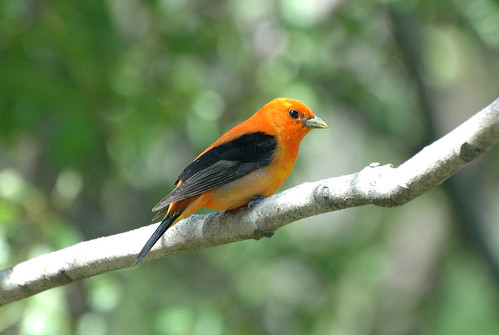
I love listening to the many varieties of bird calls and songs and trying to figure out what birds are there and what they’re doing. I saw two birds that were orange variants of scarlet tanagers scraping. I surprised two chipmunks on the grass shoulder alongside the path. They both scurried back into the bush. Since moving back into an urban environment in 1996, I rarely see chipmunks anymore. I always found them very appealing little creatures.
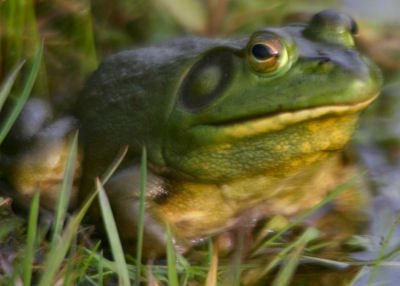

On my return back to the car a bullfrog began calling. I don’t recall hearing one since I left my hometown of Philmont in 1985. There I lived next to the reservoir and one hallmark of spring was the loud chorus of bullfrogs that I grew up loving. I’ve been looking for the Abenaki story about Gluskabe and the magical frog Oglubemu, but haven’t found it. Joseph Bruchac includes it on a storytelling tape.

My last trip to the trail was in late March when plant life was just beginning to wake up. It was nice to see the changes. My very first impression walking to the trail was that it smelled so nice there. The pendulous clusters of creamy blossoms draping the black locust trees were no doubt responsible. Blooming wild honeysuckle bushes were scattered alongside the trail, as well as deciduous trees with tiny pine cones. They’re a type of alder. There was a couple clumps of bright white bloodroot and Dame’s Rockets, or wild phlox. They are so pretty and fragrant. If you looked carefully there were beautiful yellow iris filling the mud flats along the river banks. The flowers were shaped like Siberian or Japanese iris, not bearded. They’re naturalized invasives from Eurasia.


For the past week I’ve had trouble getting to sleep. The day before I didn’t fall asleep until 6 a.m. I only had 5 hours of sleep. It was a beautiful late spring day. I made myself go out to the park. I started walking with more energy than I’ve had for ages and walked farther than I ever had. I thought I was staying awake because of my antihistamine. After enjoying this walk so much I think it’s safe to believe that I’m finally getting the help I’ve craved from my allergy shots.

I was distressed to see that there was a new roadbed cutting across the trail. It seems that the powers that be decided it was cheaper to build this than replace the bridge that crossed the trail. However, I don’t like seeing the environment further disrupted by the roadbed cutting across the river channel, the ugly riprap and knowing that pollutants will flow off the surface into the water. It was bad enough that the railroad was built along the river shore to forever alter the ecosystem in the first place. At least nature was allowed to refresh the area and it’s open to the public to enjoy, unlike the New York state parks that have recently been closed.

Tuesday, April 20, 2010

Alexander M. Thatcher of Massachusetts

I have been pursuing information on my great-great-grandfather Alexander M. Thatcher for a long time with few results.  His birth date has been given as 18 July 1818.  The information on his death certificate doesn’t seem to be true.  I haven’t found a Thomas Thatcher in Pennsylvania who could have been his father.  He first appeared in documents when he married Huldah BISHOP, 14 Aug 1844, in Tyringham, Berkshire Co., Mass.  The marriage record said he was a resident of Northampton, Mass., at the time.  The family lived in Lee and Housatonic in Berkshire Co., Mass.  There is another Thatcher family in the Lee area that I haven’t found a connection to.  Alexander died from typhoid fever on 13 Jan 1880 in Great Barrington, MA.  The death notice in the paper was two lines long and gave no helpful information.  Although I don’t have census information entered into my computer program, I know I have the existing census records for him and there was no information that was helpful.

Children of Alexander Thatcher and Huldah Bishop:

Julia Maria Thatcher, b. 7 July 1845, MA, d. 11 June 1855.
Eugene Stephen Thatcher, b. 19 Aug 1848, d. 23 Nov 1899, m. Alice Cordelia Rewey 6 Sep 1879
Agnes Jane Thatcher, b. July 1850.
Susan Evaline Thatcher, b. ca 1852, died 31 Aug 1875
Albert L. Thatcher, b. ca 1854, d. 12 Oct 1857
Spencer W. Thatcher, b. ca 1856, d. 8 Oct 1857
Cora Leona Thatcher, b. 30 Sep 1858, d. 18 Jul 1892, m. Henry Franklin Winchell 11 Aug 1857
Arthur L. Thatcher, b. 1861, d. 1944
Caroline Thatcher, b. 1 Sep 1863, d. 28 Dec 1943

I think of the state as unknown because three different states have been given. Although his father's name was listed as Joseph Thatcher on his death certificate, he doesn't fit with the family of any known Joseph Thatcher. I have marriage, death and census records, as well as a deed and an obituary.  They give very little information.  There are few photos of family members.

I have developed four hypotheses about his family background.
  1. Alexander came from somewhere along the Atlantic seacoast in Massachusetts.  So far I haven't found him in any available Massachusetts records.
  2. Immigrants to Northampton also came from along the Connecticut River Valley. I learned that some Thatchers in New Hampshire and Vermont originally came from southern Connecticut.  I need to go to the library of the Connecticut Valley Historical Society in Springfield, Mass., to search through its records.
  3. Alexander's real last name was something else.  In upstate New York and New England it's common for French-speaking people to move down from Canada and change their name to something English. This was especially common if the individual also had Native ancestry.  My great-great-grandfather's real last name could have been LeChaume, Chaume or Chaumet.  For this I also have to go to the Connecticut Valley Historical Society since they have border crossing and other French Canadian records.
  4. I'd almost forgotten the era that Alexander was born in.  Slavery was still an institution in the South.  It is possible that he was a light-skinned black who escaped on the Underground Railroad going along the Mid-Atlantic and took the last name of a conductor who helped him.  The Thatchers in eastern Pennsylvania and New Jersey were Quaker, who were early abolitionists.  DNA testing of a male relative may help here.

Friday, December 25, 2009

A Public Radio Christmas

As a single woman, I find the holiday season to be rather lonely. National Public Radio (NPR) definitely cheers the season up for me.

Today I caught the last part of Jonathan Winter's reading of Charles Dickens' A Christmas Carol.

Accompanying me down the road to my mother's place was Jay Ungar and Molly Mason presenting The Pleasures of Winter. I greaty enjoyed hearing unfamiliar Christmas music, French Canadian and Appalachian shape note singing. You can go to PRX to listen to it or purchase the album recorded live in Poughkeepsie.

On the way from my mother's I was sorry to hear I missed part of A Car Talk Christmas Carol with the Magliozzi Brothers having irreverent fun with the holiday. You can go to their web site to hear the fun you missed.

After that I learned how the Christmas Price Index issued by PNC Wealth Management changed from Marketplace. Find out for yourself if it's still affordable here.

NPR also reports that some homeowners are giving up paying their mortgages because the value of their homes have plummeted. The mortality rate for the H1N1 virus among American Indians and Alaskan Natives is four times higher than for the rest of the American population.

We need some holiday cheer wherever we can find it.


Thursday, December 3, 2009

The Beman Brick Wall

Every person researching his or her family eventually does what we call hitting a brick wall. S/he finds a person for whom s/he can’t find information on parents or family. It’s not uncommon to have several brick walls. One of mine has been Lydia, the wife of Isaac Beman. Isaac was born 7 January 1755 in the Town of Kent, Litchfield County, Connecticut. His parents were Thomas Beman and Bethia Tracy. It is documented that his wife’s first name was Lydia, but I’ve been unable to find more information on their marriage or Lydia’s family.

This was a time when researching more than one family was helpful. I found my way to a genealogy board on Northeastern Native American genealogy that no longer exists and information on Zephaniah Wix and his family. I found some interesting coincidences.

Isaac Beman’s hometown of Kent, Conn., bordered on the west the Town of Cornwall, where the Wixes lived. Isaac first enlisted to fight on the Patriot side of the American Revolution in 1775 from the Town of Warren. Lydia’s brother Uriah, two years older than Isaac, also served. He first enlisted 12 June 1776. At one time he served under Captain Eli Catlin, the father of artist George Catlin. For almost a year Isaac and Uriah were stationed at the same place at the same time, including summer months in Berkshire County, just over the border from Northwest Connecticut. It seems reasonable since there was no fighting in the area that both men would take advantage and go home to let their families know they were all right. Later in 1777 both men participated in the defense of Philadelphia. After Zephaniah died by 24 January 1777 the family moved to the Town of Warren where Isaac already had contacts.

Isaac and Lydia settled in the Town of Chatham, Columbia County, N.Y. Isaac became active in the North Chatham Baptist Church. They had ten children:

Lydia Beman was born in 1780.
Jacob Beman, born 10 Mar 1780; married Achsah Conger, 7 Dec 1814; died 15 Feb 1868, Bennington, Bennington Co., VT.
Deborah Beman, born 1782; married Joseph Hicks Rider, 1799, Chatham, Columbia Co., NY, USA; died 1818.
Abigail Beman was born in 1784.
Elizabeth Beman was born in 1786.
Delilah Beman, born 18 May 1790; married Abraham Ashley, 1810; died 7 Dec 1853, Chatham, Columbia Co., NY.
Isaac Beman was born on 11 Mar 1792.
Esther Beman was born in 1794.
Melinda Beman was born in 1796.
Alexis Beman, born Jun 1804, , , CT, USA; married Mary Modher, abt 1825, Oakland, , MI, USA; died 1856, Highland Township, , MI, USA.

I have a feeling that my ancestors traveled a lot more than we think. I don’t know how my ancestor John L. Winchell who was born in northwestern Connecticut and lived in Dutchess County and Berkshire County met and married a Quaker woman from the Town of Chatham.

A few years ago I bought a portrait in a local consignment shop because the woman in it looked so much like my paternal grandfather. I wish the owner had a provenance for it, but I have the feeling it is my great-great-grandmother Winifred Olivia Ashley. Whoever she is, her features say she had Indian ancestry. I include a photo of the portrait and a photo of my paternal grandfather Earl Winchell with his daughter-in-law Cathy Collier Winchell.


Winifred was the daughter of Delilah Beman and Abraham Ashley Sr. My Aunt Kate said she was told that the Indian in the family was Pequot. I’ve found Mohican and Wappinger in the family so far, not Pequot. There’s also the possibility it was Paugusett since there were Paugusett people documented in the area and the first chief of the Schaghticokes in Kent was actually from that group. In addition last year I had my MtDNA tested by the Sorenson Molecular Genealogy Foundation. I found it was very close to that of the Wix family. I don’t understand how the testing works, but that was the result I found.

I think I have good circumstantial evidence that Isaac Beman’s wife was Lydia Wix from the Town of Cornwall, CT. I hope sometime in the future to find evidence that will prove this.

Thursday, September 24, 2009

Forgotten Patriot Prisoners

Forgotten Patriots: The Untold Story Of American Prisoners During The Revolutionary War by Edwin G. Burrows is a fascinating but horrifying account of the British treatment of Patriot prisoners during the American Revolution. If I ever learned of this it was only in passing and not given much notice.

As a result of the Battle of Brooklyn on 27 August 1776, the British Army held 31 officers and more than a thousand enlisted men as prisoners of war and needed somewhere to house them. Nearby Kings County was rural and Loyalist, and the British needed their physical and political support. Officers were at first housed under a gentleman’s agreement in private homes there. To house the enlisted men, the British began to take over public buildings in New York City. Liberty House, Livingston’s and Van Cortlandt’s Sugar Houses, the Old North Dutch Church, Old City Hall, King’s College, the alms house, all non-Anglican houses of worship were all employed as military prisons.

Four hundred men were the first prisoners to be put on board the Pacific, Lord Radford, Mentor, Whitby, Grosvenor, Argo and Jersey ships. Some were moored in Wallabout Bay, surrounded by salt meadows and mud flats.

According to Thomas Stone of Connecticut, during the winter of 1777-8, seven to ten men died a day in his prison. Levi Hanford from the same state wrote later about his stay in Livingston’s Sugar House:
I have had men die by the side of me in the night, and have seen fifteen dead bodies sewed up in their blankets and laid in the corner of the yard at one time, the product of one twenty-four hours.
Every morning at 8 o’clock the dead cart came, the bodies were put in, the men drew their rum, and the cart was driven off to the trenches…. Once I was permitted to go with the guard to the place of interment, and never shall I forget the scene that I there beheld; they tumbled them into the ditch just as it happened, threw a little dirt, and then away. I could see a hand, a foot, or part of a head, washed bare by the rains, swollen, blubbering, and falling to decay.
The author summed up the prison experience:
[Andrew] Sherburne’s account contains particularly vivid and believable descriptions of four water, disgusting food, absurd overcrowding, vermin, disease, and grievous suffering (such as the man whose feet were so badly frozen that when the dressing were changed, “I saw the toes and bottom of his feet cleave off from the bone, and hang down by the heel.”) [Reverend Thomas] Andres writes convincingly about the terror he felt at night as a prisoner, confined in utter darkness with hundreds of other sick and desperate men—men fighting over scraps of food, men driven mad by ship fever, over dying.
The British government refused for a long time to acknowledge the wretched condition of its Patriot prisoners or to consider the exchange of any because it didn’t want to give any validity to the Patriot cause. It was only when it needed more men that any negotiations were undertaken. The overcrowding conditions were never reduced. It was only through the selfless spending by Lewis Pintard of tens of thousands of pounds of his own money that prison conditions were alleviated. Pintard was never fully reimbursed by the Continental government.

Patriot military and sympathizers were held until the end of the revolution. Burrows estimated that 11,000 died on board ships in Wallabout Bay, and between 15,575 and 18,000 in New York City, making a total of 24,550 to 30,000 dead Patriot prisoners. There were only 813,000 white males of fighting age in the colonies.

Thursday, August 27, 2009

1902 Skeeters Family Reunion, Indiana


This photo was provided to me by Sally Skeeters. Only one person in this photo has been identified. If you can recognize anyone in this photo, please contact me.

My great-great-grandmother was Mary Skeeters, who married William Harvey Wilson 24 January 1844 in Parke Co., Indiana. She was born about 1828 in Kentucky, the daughter of David Skeeters and Catherine Turner. William Harvey was born 3 December 1820, Greenfield Township, Licking County, Ohio, the son of William Wilson and Rachel Wells. He died 28 October 1862 in Parke County. Mary died 21 June 1890 in the same county.

Their children were

William Graham Wilson, born about 1845
Isabel Wilson born 1848 in Indiana. She married Samuel Haworth in 1866.
Pratt Wilson born 1851
Alice Wilson born 1853. She married James Collins.
Loretta Wilson born 1855. She married James Hiller.
George S. Wilson, born 30 December 1858 in Parke County. He married my great-grandmother Viola V. Hise 31 March 1882. He died 23 January 1901.
Clara Wilson born about 1862 in Indiana

I have never seen any photos of this family. If you are related and have some to share, I wish you would contact me.

Thursday, July 30, 2009

Henry & Hudson & The Mohican Indians

Recently I attended Henry & Hudson: The Namesake Celebration at Hudson, New York. New York State and the residents of the Hudson River Valley are currently celebrating the 400th anniversary of Henry Hudson’s encounter of the river that now bears his name and its original inhabitants. In the Hudson area they were the Mohican Indians, who called the river the Muheconnetuk, the river that flows both ways.

The celebration was held at the new Henry Hudson River Park, created where once six large oil tanks stood. It is a lovely little park, a good reuse of the land. From there you can see the Athens Lighthouse and the Middle Ground Flats, now an island in the river between the cities of Athens and Hudson. To the south despite a hazy sky you could see the Catskill Mountains. The Mohicans called these the Blue Mountains.

Also present for the day was the replica ship of the Halve Maen, the Dutch ship that Henry Hudson sailed to the New World for the Dutch East India Company. Captain William Reynolds said there were long lines of people waiting to go on board since 9 a.m. that day. When I left at 4 p.m., there was still a long line. While people waited, they could view a display of native artifacts and antique navigational instruments, and listen to Dutch songs performed by Nanne & Ankie.


My friend Steve Comer and I had been invited to represent the Mohican people. Steve had a display on the Mohican Nation and its history. I prepared a binder with information on my father’s paternal family descended from Mohican and Wappinger people. I also brought my finger-weaving with me, giving people a brief insight into native technology.

It was a very pleasant day. The rain stayed away for most of it. I’ve always loved being by a body of water, whether a river, lake or ocean. I enjoyed talking to the people who came by. While waiting in line to board the Halve Maen (that unfortunately I didn’t do), I had an enjoyable conversation with a very nice Naval commander from downstate and his brother, who brought his family. They surprised me greatly by asking how to get to the bank of the “lake” in Philmont. They definitely asked the right person since I lived for 19 years in a house on the bank of the Philmont reservoir. I think it was the best view in town